Friday, October 21, 2011

How're we doing (Oct 2011 Edition)?
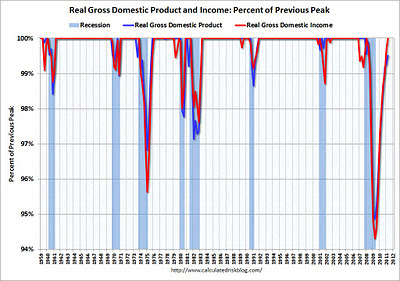

The economy is still in a funk, way below its most 2008 peak. Look at Personal Income, with the effect of prices taken out (i.e. "real" personal income). The great Calculated Risk blog has a chart showing these values relative to the most recent "peak". This gives us a normalized view of how much Incomes are dipping.


By this measure, we see a  5% dip, unprecedented since the Great Depression (pre-1960 not shown). However, we have fully rebounded now -- at least by this one measure.

One problem with this measure is that it includes "transfer payments". Since a government can borrow to pay welfare, let's subtract these payments and see what that looks like.
(Click here for original chart)

This second chart excludes transfer payments, and shows:

  • a larger (10%) dip
  • we have not fully rebounded

By this measure, we are half-way back to the peak. If we extrapolate the line upward, we'll probably be back to peak in 3 years or so.
(Click here for original chart)

Importantly, we should not simply extrapolate that line upward. Some good economists are predicting a "double-dip" just around the corner. So, the line could turn back down, or it could slow, or it could flatten.

Nevertheless, the good news is that we were down 10%, and though we might head back there again, a 10% shrinkage is far from the collapse of civilization. 

Applause Button

Web-based radio is not really a broadcast, sent out to the world at large with anyone able to pick it up. Each receiver connects to the "broadcaster". The connection is potentially two-way.

Advertisers could use "narrow-casting". Imagine you and your neighbor are -- separately -- watching the same program on an IP-based TV. In the ad-break,  you see an ad for diapers while she sees one for arthritis drugs. Even in one home, your teen's TV could receive different ads than you do.

A broadcaster could also know how many people are watching, without relying on surveys. They'll even know if you switch channels when the show gets a bit boring. One can imagine a world of even more fine-tuned, audience-driven programming (not necessarily a great thing). ["That joke did not work, but the other one was better than expected!"]

Take this one step further. Say you're watching live comedy at a club. You applaud. On web-radio, you could  press a little "applause button". Your TV remote might have an applause button too. Or, when a commentator says something stupid, you press the "boo" button.

Take this to more range-of-the moment ways to encourage the audience-mob: a studio could hook the feedback to sound effects and we can have audience participation like you've never seen before.

(From an earlier post of Mar 2006)

Monday, October 10, 2011

Bartelby, The Scrivenrer - by Herman Melville

I picked up Herman Melville's short story "Bartleby, the Scriverer" because the subtitle interested me: "A Story of Wall Street". I was listening to an audio version read with good humor. Though it had nothing to do with Wall Street, it was about an odd-ball character and I was intrigued and wanted to see how it would turn out.

Bartelby is a clerk to a lawyer -- the narrator. Though he inexplicably refuses to do certain types of work, his boss tolerates his idiosyncrasies. Bartleby is not argumentative; just the opposite: he is a study in passivity. His boss is passive too:  in his failure - stemming from pity, perplexity and "niceness"- to rid himself of this odd (and, increasingly unproductive) employee. The reader is given some explanation for the narrator's passivity, but kept guessing about the Bartleby's (lack of) motivation.

"Why is Bartleby acting like this?" With that question hanging in the air, the story held my interest almost till the end. Melville let's his reader down by providing no answer. He does not give us a choice off possible explanations (except a really silly one that comes almost as an after thought). He just teases the reader with Bartleby's odd behavior, and then walks away, like he's saying "Hmm! I'm not sure how to wind this thing up!"

Some commentators say the story reflects Melville going through a phase of depression and also his refusal to write as people expected him to. Fair enough: if that's true, the story belonged in his journal among other unpublished finger-exercises. As such, the story was pointless -- a waste of a few hours!