Sunday, June 24, 2012

Country Shares of World GDP
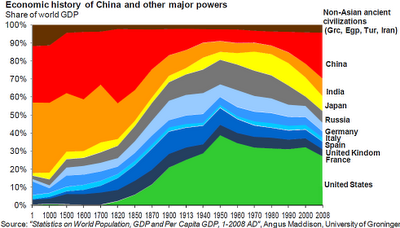
Here's a chart of world GDP, broken down by country share. (HT: Carpe Diem).
Careful with the x-axis, it is not at all to scale!
The basic idea is that India and China had large shares pre-industrial revolution, after which Europe rose. The U.S. shoots up, to over 40% of world GDP by 1950. Then, Japan begins to grow in the 1960s, and China in the 1980s.


Suppose countries end up with GDPs proportionate to their populations. What would that picture look like? I've added a bar to the right, showing the break-down of world-population. Look at the U.S. squished down, with less that 400 million out of a world population of over 7,000 million.


The biggest change is in the previously un-noticed 'rest of the world". If Africa, the Middle East and so on moved toward freedom, that could be the story of the century. 

What if they do not? Here's a chart with a new assumption. Suppose the "rest-of-world" does not increase its relative share significantly, but the shares of all the other countries did become proportionate to their populations? Here's what we would see: China and India would far outweigh all others, followed by the U.S.


None of this is a prediction, by any stretch of the imagination. I'm significantly more bullish on the U.S. in relative terms. Still, it's an interesting "what if". It also puts the so-called "U.S. decline" into perspective.

Wednesday, June 20, 2012

The French Physiocrats on Natural Order

The French Physiocrats -- just as much as Adam Smith et al. -- founded modern Economics. They had an odd theory of value, but their major contribution was to argue for individual freedom in economics.

Theory of Value:  Most physiocrats thought that natural-resources were the only fundamental economic value. When fruit grows on a tree, we can see the physical values appear in physical form. Or, we can visit a mine and see the a value like coal. However, using a very physical concept of value, the physiocrats could not see the value in transformation.  When the farmer picks the fruit off a tree  or when a carpenter assembles a table, they saw a rearrangement of value rather than a creation of new value. (In contrast, Adam Smith thought labor was the fundamental source of real value, and this too is wrong. It took the Utilitarians to come up with the notion that the valuer must be considered too.)

François Quesnay
Not "social contract": The Physiocrats objected to the subjectivity of the concept of "social contract". Advocates of "social contract" said that man-the-savage gave up some of his freedoms, and submitted to society's laws, entering into a "social contract" that binds him to obey. However, any deprivations of legitimate rights can be justified as being part of a "social contract". We need a more objective principle. Even if we use "contract" as a metaphor, it can never be a  primary justification for a law. A law is not legitimate because it is part of a "social contract", but only because it best upholds individual freedom: rights to life, action and property.

Natural order: The chief counter-hypothesis offered by Physiocrats was the notion of "natural order".  They claimed that there was a "natural order": rules and laws that would allow people to live together in society while not giving up significant freedoms. The task of political science was to discover this natural order. The razor was: protect freedoms to the maximum while enabling people to interact in society. 

The Invisible Hand: The Physiocrats groped for a concept like Adam Smith's "invisible hand" to show that individual pursuit of selfish happiness was compatible with an ideal state.  "the desire for joy... drives itself toward the realization of the ideal type of state" (Mercier de la Rivière). If true, it would reconcile their moral goal (the ideal state) with common practical goals (joy). It is a true proposition in a very broad sense that free-markets create the richest societies. However, it is also a dangerous proposition that puts the state and common-good first, and it led generations of economists down the wrong road, and ended up undermining the free-market that it set out to justify.

Summary: The Physiocrats had a quaintly physical theory of value. Their inability to step away from their basic altruistic moral code placed economics on a shaky moral foundation, and their disciples compounded this further. Nevertheless, the Physiocrats were early innovators who contributed to the foundation of Economics and who advocated for more open markets. For more details, see: A History of Economic Doctrines... Gide, Charles

Sunday, June 10, 2012

"Lombard Street" - by Walter Bagehot

Walter Bagehot was editor of "The Economist" in the 1860s. In "Lombard Street: A description of the money market" he explains the workings of British fractional reserve banking system of his time, under a gold-standard currency. Bagehot provides a lot of interesting tid-bits about the founding and evolution of banking. Of most relevance to today is his explanation of the benefits and dangers of fractional reserve banking and his recommendations of how to best manage a flawed system that has a single central-bank.

The Bank of England, then private, was the de facto central bank. Bagehot laments the statism that put the bank in this position. However, he thinks it is quixotic to think that the fundamental British structure can be changed.

Of course any man-made institution can be changed. Nevertheless, within the scope of his assumption, he makes sensible suggestions for managing a central bank. In today's world of powerful central banks Bagehot's book is relevant again.

Fractional reserve banking monetizes an array of assets:  Bagehot contrasts Britain's system with other European ones. In a fractional reserve system, deposits of gold are slowly converted into other materials -- factories, railways and so on, with only a fraction actually remaining in the form of gold, even though the whole of it is subject to a promise to be paid out in gold "on demand". Whatever one might think of the fragility (or even the honesty) of such a system, it does have some advantages.Each bank-note represents a de jure claim to gold, but it represents an indirect de facto claim to productive assets. Instead of monetizing gold alone, it monetizes houses, ships, inventories, toll-roads, etc.

A store of value: One role played by money is as a "store of value". In a fractional-reserve system,  productive assets are used as a store of value. Over time, such assets create more value by being put to some use. Two decades later, even though the original machines may be worn and gone, some part of the value produced would have been re-invested in newer machines, in different factories, and so on. The value would have been stored and increased, even though it would have changed physical form.

This, notes Bagehot, is the huge benefit of the British system of banking. He says, "...much more cash exists out of banks in France and Germany, and in all non-banking countries, than could be found in England or Scotland, where banking is developed. But that cash is not, so to speak,...attainable.  ... ... the English money is 'borrowable' money."

Borrowing and Class mobility: In addition to using productive assets as a store of value, this ability to borrow also allows the faster rising of a class of entrepreneurs who do not have sufficient capital of their own.  "it prevents the long duration of great families of merchant princes, such as those of Venice and Genoa, who inherited nice cultivation as well as great wealth, and who, to some extent, combined the tastes of an aristocracy with the insight and verve of men of business. These are pushed out, so to say, by the dirty crowd of little men."


Problems loom: Bagehot is quite aware of the problems with the English system of fractional-banking: "in exact proportion to the power of this system is its delicacy". It's impossible for individuals to examine and understand the assets and capital structure of every bank whose notes they accept. Since non-gold assets are monetized, these assets may unexpectedly lose value. A bank that has lent unwisely can end up insolvent.

Further, even if the loans are good, the duration-mismatch is a problem (i.e. the bank has promised to pay out cash "on demand", but cannot call in its loans in short order). If there is an unexpected rise in the demand for money, the money may not be there.  "The 'cotton drain,' as it is called—the drain to the East to pay for Indian cotton during the American Civil War took many millions from [Britain] for a series of years." Even a very solvent bank could be ill-liquid: it can pay its depositors eventually, but not if they want their money now.

Dealing with Bank runs: From the experience of bank-runs, Bagehot came up with principles a central bank ought to use. He recommends larger fractions be held as reserves by individual banks. For the central bank, he has this advice:
  • Do not help insolvent banks. Instead, recognize their situation and treat them like any bankrupt. "The cardinal maxim is, that any aid to a present bad Bank is the surest mode of preventing the establishment of a future good Bank."  
  • Help solvent banks by lending large amounts freely. A panic will not be stemmed by tiny modicums of liquidity. 
  • Charge penalty rates for rescuing a ill-liquid but solvent bank (of course this means that the bank is solvent even given the margin for error and the high penalty rates). "Very large loans at very high rates are the best remedy for the worst malady of the money market when a foreign drain is added to a domestic drain."

    High rates pull money back into the banking system, and draw gold from abroad. If the assets are truly good, there is some rate at which people will be induced to keep their money in the banking system -- even if they shift it from one bank to another. "If the interest of money be raised, it is proved by experience that money does come to Lombard Street,..." These days, the Fed violates the principle of not lending to insolvent banks, and also the principle of raising rates. Instead, rates are lowered at such times.

Summary: This book is not for readers with only a casual interest in the subject, but it is a good source for those who are interested in the history behind our current system, and a great discussion for anyone studying fractional-reserve banking. Few will agree with all Bagehot's advice, but the book offers much wisdom to ponder. A must-read for any serious student of banking.


Sunday, June 3, 2012

Government Economic Policy

A post at Krazy Economy talks about "austerity" (e.g. in Europe) being a failed program and says that production and freedom are the key. I agree. Do not listen to those who are overly shrill about government money-printing or government deficits. Printing and deficits are bad, but freedom is more fundamentally important to an economy.

One way to classify a government's economic intervention is: structural, fiscal and monetary.

Structural policy and laws: Does the law recognize property rights or is the country communist? Do the courts enforce such rights or are they slow and corrupt? Are owners burdened by regulations on the use of their property: environmental laws, zoning laws, minimum wages, unions, protectionism?

Fiscal policy: What fraction of GDP is spent by the government? On what is it spent? What is the structure of taxes? Do taxes pay for spending, or does the government owe debt?

Monetary policy:  Does the government use fiat money (always "yes" these days)? Does the money supply grow slowly or rapidly?

Economics is born on a Freedom Platform: Classical economists like Adam Smith argued for more individual decision making, setting people free from structural constraints like protectionism, rationing, and government price-fixing. The West adopted many of their prescriptions with great success. More recently, Taiwan, South Korean, China and India have shown that structural changes -- increased freedom -- can do wonders for an economy. (Also see de Soto's main thesis.)

Weeds of intervention never rooted out: Unfortunately, alongside their better arguments, some classical economists -- like Ricardo and John Stuart Mills -- were laying the foundation for more government intervention and wealth-redistribution. The climax of these ideas came in the form of the Russian revolution. In the U.S., it came in the form of FDR's NRA, from American intellectuals who -- rejecting the invisible hand -- thought the Soviet system would surpass the U.S.

Fiscal policy ascendant: The NRA was struck down by the SCOTUS. This meant that U.S. government intervention would have to come in drips over decades instead of on fell swoop. Instead, John Maynard Keynes was the flavor of the decades to follow, pretending to rescue Capitalism, not undermine it. Politicians did not need to apologize for spending; deficits bring prosperity! Until: "We're all Keynesian now".

Monetarists bring back Adam Smith: Keynes's ideas brought no prosperity, only rising prices, while government intervention continued relentlessly. The tide shifted to the ideas made popular by Milton Friedman. (Hayek's work had influence here, though it was less "pop".) Though he was a monetarist to other economists, his contribution to the lay-public was to popularize older classical ideas: having individuals Free to Choose. This was a revival of Adam Smith, flaws and all.

Monetarism itself is flawed: Friedman said, "Inflation is always and everywhere a monetary phenomenon." This is does not speak to more fundamental causes. I prefer John Hussman's formulation: "... ... significant inflation is ultimately not a monetary phenomenon as much as it is a fiscal one." Though many detailed theories and prescriptions of the monetarists are wrong, they did call for monetary discipline, and -- by implication -- for fiscal discipline, both of which are good things.

Deregulation: More important than monetary and fiscal discipline was the resurgence of classical ideas about free-markets. Nixon started to toss in the towel on Keynes. Even Carter started to deregulate. Finally, deregulation became the buzzword, climaxing under Thatcher and Reagan. The "Asian Tigers" bought in, and China followed a decade later, with India finally waking up too.

Supply-side spin: For all the talk of "supply side"and tax-cuts from pop-economists like Larry Kudlow, I suspect history will show that Reagan's real contribution was to popularize an ideology of deregulation, small-government, union-busting and privatization. The same with Thatcher.

Partial freedom:  Partial deregulation can be disastrous. Witness California's attempt to "deregulate" the power industries, by imposing various regulations inspired by another Chicago-school economist, Frank Knight, and faulty ideas like "perfect competition". The biggest blow-up came the housing crisis, where the government had created a facade of a free-market (GSEs like Fannie and Freddie were privately owned, with stocks trading on the market, and banks were freed from Glass-Stegall), when the reality was that the government was implicitly guaranteeing  GSE debt, and the Feds and the FDIC were underwriting banks and even hedge-funds (e.g. LTCM). [The "socialization" of risk and failure.]

Statism resurgent: After two stock-market downturns, it is not surprising that public mood -- typically informed by superficiality -- has swung against deregulation and Capitalism. Obama's anti-business rhetoric has found fertile ground. Both Bush and Obama responded with "borrow-and-spend", and that has come to naught. The Fed's response has been to "push on a string" with lower interest rates, and that has come to naught in the face of credit-deflation.

Austerity is not bad, just insufficient on its own: Of course austerity is a good thing if it means not printing money, and living within one's means. Further, when austerity is forced on a country, it can force structural change -- as increased freedom may be seen as the only practical and politically-viable solution. There are many examples of the World bank forcing austerity on a country. There are instances -- as in India -- where this caused the first erosion of statism that had grown for decades. Austerity can be good; freedom is more fundamental. We don't want North Korean style austerity!

Austerity in the U.S.: Despite the Federal stimulus, there has been some austerity in the U.S., with welcome effects. School districts, libraries and cities have cut back. Pension schemes are under scrutiny. Not enough being done? It might seem that way, but this is how change comes: with a fight (witness the recall campaign against Governor Walker in Wisconsin.) When re-distribution schemes are rolled back, recipients will fight even if they know the scheme is unsustainable. This is how groups negotiate in democracies.

Real Hope and Change:  Freedom brings prosperity, and prosperity wipes out past sins. The huge WW-II debt -to-GDP burden in the U.S. was erased because GDP grew faster than debt. The U.S. must undo regulations if it is to grow and work off its debt. When Obama wanted to stop Boeing from building a plant in South Carolina, he was fighting to keep some wealth-redistribution in place. Banning a project like the Keystone pipeline is pointless, suicidal lunacy. The U.S. is seeing a boom in energy production -- in both oil and gas. The government does not need to invest in this. It just needs to get out of the way. It just needs to allow people to get on with the business of production. The U.S. actually has the potential to reverse the outflow of manufacturing jobs to China. With more capital intensive production, a narrowing gap in real wages, lower transport costs, and cheap energy, the U.S. could become more competitive. Giving people freedom in their choices of healthcare would lower the one cost that threatens to run up our debt more than any other.

Our choices: Obama has nothing to offer here: he can only scold and complain. He is an anachronistic and clueless loser. Unfortunately, the GOP's nominee -- Romney -- does not show much intellectual leadership either. Still, these two are simply effects -- thrown up by voter opinion. We voters are the cause behind these politicians. If we voters can see our way to sanity and freedom, success is easy. The only things holding the U.S. back are the self-imposed shackles that voters have asked for over the years.