Posts

von Mises on the Quantity Theory of Money

Reading von Mises a while ago, I was surprised to see him speak against the Quantity theory of Money, but what he said made a lot of sense. A recent Facebook comment sent me back looking for the source, and I decided to blog a few choice quotes, because others may find it interesting. My summary of von Mises's position is as follows: The supply of money is an important factor in its value. This is the element of truth in the Quantity Theory However demand for money is the other factor. The quantity theory gives short shrift to demand for money. (One must look to individual decision-making processes and their objective context to understand the demand for money. One cannot start with the aggregate demand for money.) Even if supply were the only factor, it is wrong to assume the value of money will change in direct proportion to the change in supply It is also wrong to assume that an increase in supply of money changes all prices generally and similarly A good the...
How're we doing (Oct 2011 Edition)?

Image
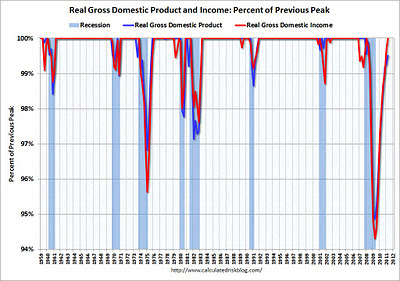
The economy is still in a funk, way below its most 2008 peak. Look at Personal Income, with the effect of prices taken out (i.e. "real" personal income). The great Calculated Risk blog has a chart showing these values relative to the most recent "peak". This gives us a normalized view of how much Incomes are dipping. By this measure, we see a  5% dip, unprecedented since the Great Depression (pre-1960 not shown). However, we have fully rebounded now -- at least by this one measure. One problem with this measure is that it includes " transfer payments ". Since a government can borrow to pay welfare, let's subtract these payments and see what that looks like. ( Click here for original chart ) This second chart excludes transfer payments, and shows: a larger (10%) dip we have not fully rebounded By this measure, we are half-way back to the peak. If we extrapolate the line upward, we'll probably be back to peak in 3 years or so...

Applause Button

Image
Web-based radio is not really a broadcast, sent out to the world at large with anyone able to pick it up. Each receiver connects to the "broadcaster". The connection is potentially two-way . Advertisers could use " narrow-casting ". Imagine you and your neighbor are -- separately -- watching the same program on an IP-based TV. In the ad-break,  you see an ad for diapers while she sees one for arthritis drugs. Even in one home, your teen's TV could receive different ads than you do. A broadcaster could also know how many people are watching, without relying on surveys. They'll even know if you switch channels when the show gets a bit boring. One can imagine a world of even more fine-tuned, audience-driven programming (not necessarily a great thing). [" That joke did not work, but the other one was better than expected! "] Take this one step further. Say you're watching live comedy at a club. You applaud. On web-radio, you could  ...

Hoover helping Bolsheviks

Image
" The Great Famine (PBS documentary) " hit Soviet Russia in 1921, when war and communist mismanagement exacerbated a period of bad weather.  The scenes were pitiful: hungry people looking like skeletons from the Nazi camps, 10 million dead, and stories of cannibalism. The U.S. came to the rescue, sending tonnes of food to Soviet Russia. While "American Relief Association" had people in Russia, managing the supplies, local commissars often managed to use the food as a political tool to favor some and deprive others. The U.S. helped the Soviets, until the Lenin realized that he needed to allow a little more economic freedom with his "New Economic Plan".  In the U.S., leftist journalists helped the Soviet cause. They said food aid should not be used to help just ideas and people who were more amenable to U.S. policies. So, in truly christian style, the U.S. should turn the other cheek, love its enemies, and help all alike. Herbert Hoover led t...

Recessions and Wages

Conventional economic theory says that over-supply typically causes a fall in price , and this cheaper price will cause more demand , till there is no longer any over-supply. Applied to the labor market, when a recession throws people out of jobs, wages should fall, the lower wages should make previous employment levels profitable to businesses, and the unemployment rate should fall back to its norm. Yet, this does not happen. By and large, managers prefer to fire people rather than reduce wages. Imagine that a recession hits and the unemployed find they must take an average 10% cut in their wages to get similar work. If a firm wants to cut its wage costs by 10%, it seems logical (in a Vulcan way) that the management would force a 10% wage-cut rather than letting 10% of its workforce go. However, managements mostly choose the latter. Understandably, such managements prefer to cause pain to a few people who are then no longer with the company, rather than cause pain across the...

Public libraries charging fees

With the economic downturn, a lot of public libraries are pressed for funding. Some have cut services, others have closed. In California, a $80 "out-of-county fee" has gone into effect . In Wisconsin, they're considering charging for CDs and DVDs In Topeka, they're adding late fees where they had none In Ridgewood, they will charge businesses (like tutors) who use their meeting rooms Prescott, Arizona is discussing usage fees A quote from a director of the American Library Association, says Selected ALA members will begin charging an annual fee of $10 for each issued library card. Each borrowed book will cost $1 and we think that’s fair. Use of a whole book for more than a week, well it’s quite fair when one considers the retail cost avoided All this is a good thing, and a far cry from the situation during the housing boom of a the early 2000's when a lot of libraries took on debt and expanded. I hope it sticks.

Britain's Annual Army act

I like this constitutional check from Britain. The Army Act is only ratified for a year at a time From Wikipedia ... that the maintenance of a standing army in time of peace, unless with the consent of parliament, is against law. Each session therefore the text of the act had to be passed through both Houses clause by clause and line by line. The Army Act, on the other hand, is a fixed permanent code. But constitutional traditions are fully respected by the insertion in it of a section providing that it shall come into force only by virtue of an annual act of parliament. This annual act recites the illegality of a standing army in time of peace unless with the consent of parliament, and the necessity nevertheless of maintaining a certain number of land forces (exclusive of those serving in India) and a body of royal marine forces on shore, and of keeping them in exact discipline, and it brings into force the Army Act for one year.