Posts

Metric system or Base-12 ?

The metric system (base-10) is easier to remember than older systems. Every unit is uniformly 10 times more than the next smaller one. Or 10, 100, 1000 times, if we consider only important ones. Also, by using prefixes like "kilo-" there are less words to remember. We use it in "kilogram", "kilometer". For length, we just remember "meter" and apply the prefixes. We don't have to remember: "inch", "foot", "yard", "furlong", etc. However, the older systems came about for a reason and do not pooh-pooh our ancestors for using Base-12 systems. They makes it easy to get "a quarter", "a third", or "half". If things were sold by "the tens", the green grocer could give you "a half", but couldn't give you "a third" or "a quarter" without cutting up some fruit and vegetables (or eggs). I was reminded of this recently, while watching a tu...
23andMe - The Birth of the Crony Capitalist

The FDA has now allowed 23andMe to give their customers some health-related information. This is not everything: it is only the results tat the FDA considers more reliable. On the face, this might look like a good thing, but it is probably the first step to corrupting one more little industry. Already, 23andMe is running ads saying it is the only genetic testing company offering FDA-approved health results. This is really deceptive because the FDA only approved a small slive r of their tests and because competitors can do the same even if the FDA has not approved them yet. Consider the people who run 23andMe. Until recently they were fighting against FDA control. Now, how would they view a competitor who wants to offer a non-approved test? They'll probably insist on a "level playing field". Fast forward a year or two and they'll have a relationship with the FDA and may even sue a competitor who tries to offer something new saying it does not need FDA approv...

Who needs teamsters when we have SWAT teams?

When oil was first discovered in Pennsylvania, it was transported to the nearest rail head by horse. It was poured into liquor barrels, put on a cart and pulled by a team of horses. In 1865, Samuel Van Syckel procured a right of way and built a 5 mile pipeline . He faced a lot of technical challenges. The oil had to be pumped, and the pipeline's joints would need to withstand high pressure. Van Syckel was working with 15 foot sections of 2-inch wrought pipe. After sabotage by unhappy teamsters,  he hired guards to protect the line, and it was successful enough (he charged $1 per barrel) that he built a second line soon after.  Today, pipeline builders don't just have to get a right of way from farmers. They have to petition the government. And, they do not face desperate teamsters wielding pickaxes in a futile attempt to hold back competition. Instead, the government does the job more effectively. If the people's government, duly elected, says "no", thei...

How're we doing? (A review of 2014)

Image
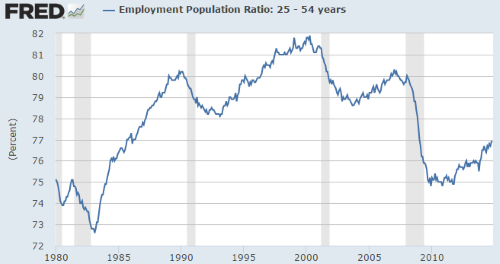
Overview:  Like last year, 2014 gave us a s lowly improving economy, and a rocketing stock market ! Since the 2007-08 downturn, most measures of the economy have stabilized and have started to improve from their bottom. Even total-employment got back, though the more important number (Employment-to-population) is still low.  The broadest GDP measure has been increasing very slowly. House-prices came well off their bottom, someway half-way to the old peak, but have recently flattened for a few months. Meanwhile, the stock market is at an all-time high. Corporate profits are high since GDP is growing slowly while firms have kept a reign on costs. Companies have kept buying back stock at above-average levels. This is different from the type of excitement that drove the dot.com boom, because it does not cascade into higher salaries and expenditures: quite the opposite. In the short/medium term, this is "blah" for employment numbers and wages. Here are some of the detail...

Personal Balance Sheet repair

Image
Private debt is often a bigger problem than government debt, in a mixed economy. Governments encourage private borrowing, and force some citizens to underwrite the losses of others. The great recession is essentially a tale of private debt gone wild. Greenspan's folly: After the dot.com bust, Americans did not tighten their belts for long. Look at the first chart. After dropping slightly for two years (2003-04), debt payments rose as a percent of disposable income. This was Alan Greenspan's "clever plan" (TM) to get out of the recession: " borrow against your house ". A  different (private) response: Then came the housing bust of the "great recession". Bernanke would have liked to repeat the Greenspan "solution", but this time, Americans were more scared. They have been repairing their balance sheets (see 2008 and beyond). Flat levels of liability:  Meanwhile, the total   level (nominal) of household liabilities has flatte...

Voters do not want to tackle entitlements

Image
In a previous post I predicted Social Security will be around for a long while. Briefly, if you are between 30 and 50 you will likely receive social security, but you will receive less than promised if you're in the upper-middle income range. (If you're 20 or so, I have no prediction to make. I wouldn't rely on it. Still, by the time you're 30, you you can re-evaluate the situation.) The math of Social Security does not add up, but each time it has faced a crisis, the tax-rate has been raised. The Wiki has a table showing how it crept up, along with a list of changes, showing how "benefits" were cut, particularly at the higher end. Even among "conservatives", only about 10% think social security should be phased out. Therefore, the program will stay. About 30% of voters, across the political spectrum, think benefits should be reduced, while the majority (60%) want the program kept as is. This means raising taxes is the most viable political s...

Corporate Tax breaks

"Tax break" is a fuzzy term, with no objective definition. Personal tax example: My taxable wages already exclude some actual wages: my deposits to a "Health care Flex account"; the amount I put into my company's 401-K savings plan; the money my company pays directly to a health-insurance company on my behalf. The government is saying that if I spend my money a certain way, they will tax me less. Already, on the top line of my tax form, I've got three "tax breaks". Continuing on, interest from municipal bonds is exempt from federal income tax. My dividends are taxed a bit lower. My investment income is broken into two parts: short-term gains and long-term gains, and I get a "tax-break" on the long-term gains. The interest I pay on my mortgage and on student loans gets  me a deduction. Supporting a child gets me another deduction. My charitable donations earn me a deduction. Once again, the government is encouraging me to spend in certai...