Posts

Showing posts with the label ECONOMICS

EU Rates

Image
Lenders to governments run two types of risks: credit risk (the country won't pay back 100% of the loan), and currency risk (a country borrowing in its own currency can pay back the loan by "printing money"). Developing countries often borrow loans denominated in a currency like the US $, to remove currency-risk. Despite this, they have to pay higher rates of interest because they are not great credit risks. Countries have defaulted throughout history. Yet, consider the chart on the left. After European countries joined the Euro, interest rates on their borrowing became almost equal. And, notice how that finally ended around 2008, with the "great recession". Why were rates nearly equal for about 9 years? Under the Euro, countries agreed not to default (default was not envisaged).  They also agreed to stick to certain deficit limits  Finally, there was a good possibility that the EU and the ECB would come to the aid of any country in trouble, bail...

WW-1 Prosperity?

Image
"War prosperity" is an odd, but enduring myth. Wars destroy some men and material; and, they divert others from making "butter" to making "guns". Nevertheless, one hears people say things like: " spending lots of money fighting Hitler, brought the U.S. out of depression " (1) . Here's a brief look at the FIRST world-war. The pro-War case : U.S. production did boom during World War-I. When the war ended in 1918, American production volume was about 25% higher than it had been in 1914. In 1914, the U.S. was a debtor country; by 1918, the positions were reversed: the world  owed money to the U.S. Detailed WW-I timeline: Actually, the U.S. did not enter WW-I in 1914. At first, the U.S. was at peace, while producing and exporting to the warring nations. Only in 1917 did the U.S. declare war. Armistice Day was less than 2 years later, in 1918. Peace prosperity: Consider the top-most black line in this diagram. It is an index of Producti...

The French Physiocrats on Natural Order

Image
The French Physiocrats  -- just as much as Adam Smith et al. -- founded modern Economics. They had an odd theory of value, but their major contribution was to argue for individual freedom in economics. Theory of Value:  Most physiocrats thought  that natural-resources were the only fundamental economic value. When fruit grows on a tree, we can see the physical values appear in physical form. Or, we can visit a mine and see the a value like coal. However, u sing a very physical  concept of value, t he physiocrats could not see the value in transformation.    When the farmer picks the fruit off a tree  or when a carpenter assembles a table, they saw a rearrangement of value rather than a creation of new value.   (In contrast, Adam Smith thought labor was the fundamental source of real value, and this too is wrong. It took the Utilitarians to come up with the notion that the valuer must be considered too.) Not "social contrac...

Government Economic Policy

Image
A post at Krazy Economy talks about "austerity" (e.g. in Europe) being a failed program and says that production and freedom are the key. I agree. Do not listen to those who are overly shrill about government money-printing or government deficits. Printing and deficits are bad, but freedom is more fundamentally important to an economy. One way to classify a government's economic intervention is:  structural , fiscal and monetary . Structural policy and laws:  Does the law recognize property rights or is the country communist? Do the courts enforce such rights or are they slow and corrupt? Are owners burdened by regulations on the use of their property: environmental laws, zoning laws, minimum wages, unions, protectionism ? Fiscal policy:  What fraction of GDP is spent by the government? On what is it spent? What is the structure of taxes ? Do taxes pay for spending, or does the government owe debt ? Monetary policy :  Does the government use fiat mone...

Labor Turnover

Image
One of my favorite jobs-related graphs comes from JOLTS "(Job Openings and Labor Turnover Summary"). It shows how dynamic the economy really is, underneath the net numbers. Net New Jobs (monthly): First some background. Every month, the government reports how many net new jobs were created. The last month, they reported about 250 K net new jobs. In a month like January, there is a huge seasonality adjustment in these numbers. Still, if we were to average 250K per month, it would be good news. How about if we added 50,000 jobs each month? While it would be better than zero, it would end up raising the unemployment rate. Level to keep the unemployment rate from rising: Here's a back-of-envelope calculation. The U.S. has 300 million people, but only 155 million are working or want work. (Children, retirees, college-goers, housewives, and a few bums account for the rest). The population growth rate is about 0.85% per year . If we ignore age-distributions etc., the labo...

Are "Soft Landings" really softer?

Image
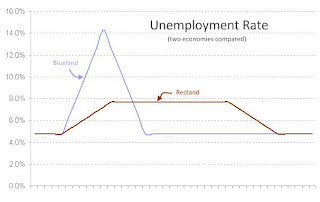
Falling off a roof, I'd rather have a soft landing than a hard one; but, does the metaphor translate to economies? Example: Imagine two countries -- Redland and Blueland -- both with  unemployment around 5%. Next, imagine unemployment shoots up to 14% in " Blueland " while " Redland " has a far milder rise to 8%. However, the rate of unemployment comes back to 5% much sooner in Blueland, while it lingers at a 8% for a while in Redland. Is there any reason to think  Redland is better off in this example? Even if we accept the notion that governments can and may engineer a soft-landing, it is far from clear that a shallower recession is a good thing, if it means extending its duration . Think of individuals: Would you rather be unemployed for 1 year or for 3 years? It's a no-brainer! A laid-off dad from my son's school told me his savings could last him six months before he starts getting desperate. For him, a short sharp downturn would ...

von Mises on the Quantity Theory of Money

Reading von Mises a while ago, I was surprised to see him speak against the Quantity theory of Money, but what he said made a lot of sense. A recent Facebook comment sent me back looking for the source, and I decided to blog a few choice quotes, because others may find it interesting. My summary of von Mises's position is as follows: The supply of money is an important factor in its value. This is the element of truth in the Quantity Theory However demand for money is the other factor. The quantity theory gives short shrift to demand for money. (One must look to individual decision-making processes and their objective context to understand the demand for money. One cannot start with the aggregate demand for money.) Even if supply were the only factor, it is wrong to assume the value of money will change in direct proportion to the change in supply It is also wrong to assume that an increase in supply of money changes all prices generally and similarly A good the...

Recessions and Wages

Conventional economic theory says that over-supply typically causes a fall in price , and this cheaper price will cause more demand , till there is no longer any over-supply. Applied to the labor market, when a recession throws people out of jobs, wages should fall, the lower wages should make previous employment levels profitable to businesses, and the unemployment rate should fall back to its norm. Yet, this does not happen. By and large, managers prefer to fire people rather than reduce wages. Imagine that a recession hits and the unemployed find they must take an average 10% cut in their wages to get similar work. If a firm wants to cut its wage costs by 10%, it seems logical (in a Vulcan way) that the management would force a 10% wage-cut rather than letting 10% of its workforce go. However, managements mostly choose the latter. Understandably, such managements prefer to cause pain to a few people who are then no longer with the company, rather than cause pain across the...

Family Tree of Economists

Image
Studying the history of a subject gives one a deeper perspective on the subject. The NOT PC blog has a nice graphic, showing the " Family Tree of Economists (click here) " A good book on the subject is "The making of Modern Economics"