Posts

Personal savings flat once more

Image
A downturn in the economy or the stock-market usually causes people to pause spending to see where the chips will fall. Even people/businesses who think their jobs/revenues are relatively secure become cautious. This caution, in turn, implies less sales for some businesses, creating a downward spiral. Only to a point, though: as it spirals down, business profits start to increase and personal savings increase too. Confidence starts to come back. Savings rate: The red circles in this chart show temporary increases in the Personal Savings Rate during recessions. Unfortunately, after each recession the personal savings rate started to decline once more. We see that the savings rate has flattened once again. This is the flip-side (and downside) of confidence. [Update (2017/June: This rate still remains mostly above the 5% mark] Retirement confidence: Compared to previous years, workers who are still employed are less confident that they will have enough money to live ...

How're we doing? (A review of 2013)

Image
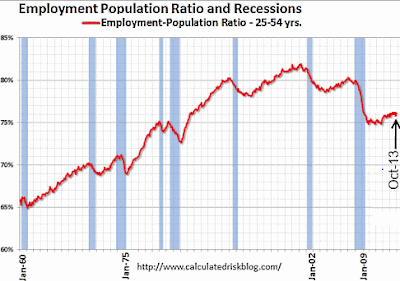
Overview:   Slow economy, rocketing stock market ! Since the 2007-08 downturn, most measures of the economy have stabilized. Despite this, total-employment is still lower. The broadest GDP measure has been increasing very slowly. Meanwhile, house-prices have turned up for the last two years, and the stock market is at an all-time high. Corporate profits are high since GDP is growing slowly while firms have kept a reign on costs. In addition, companies have been buying back stock at above-average levels . This is different from the type of excitement that drove the dot.com boom, because it does not cascade into higher salaries and expenditures: quite the opposite. In the short/medium term, this does not bode well for employment numbers and wages. Here are some of the details: Employment: Though the unemployment rate has been falling, it is mainly because so many people (particularly younger folk) have given up looking for jobs . For the core age-range 25-54 years, employ...

Twitter feed

If you use Twitter as your main article/link "feed", use the button below to get a tweet whenever a new post is added to this blog. Follow @PracGoodTheory

Smoke and Mirror recommendations -- Vox Populi

Image
What do socialite Lois Pope and lawyer Tim Broas have in common? Someone is paying for Google-searches of their names. "Reputation" firms offer a few cents for each search. Some paid-search is legit (e.g. keeping tabs on where one ranks), but most is an attempt to "game" widely-used search-engines.. Fake everything: Other than search, "workers" will post fake reviews for books, and even for photo-portfolios put up by models. They will plagiarize articles and post them to a site that is pretending to be informative. Recently, a businessman was convicted for posting negative Yelp reviews about his competitor's business.  Another businessman  claims that Yelp offered to bury negative reviews for a fee. The New York attorney recently went after people posting fake reviews to Yelp, and other such sites. Even the Israeli government is paying  students for positive reviews. Wikipedia just cancelled 250 sock-puppet user accounts used by a paid PR firm....

The Great Degeneration - by Niall Ferguson

Image
In " The Great Degeneration ", Niall Ferguson argues that the west is stagnating because of broken "institutions". The cause of Ascendancy: Ferguson rejects Max Weber's "cultural" explanation of a Protestant-driven industrial revolution. After all, the same root "culture" ended up in a very different East and West Germany or North and South Korea. While Jared Diamond's "geography" might explain why Eurasia was wealthier than the Americas, it does not quite explain the ascendancy of Western Europe. Finally, iIf genes are crucial, how to account for the gap between East and West German IQ scores, and how to explain why Eastern genes did relatively well until the last few centuries? The crucial factor, says Ferguson, is the socio-political institutions adopted in some countries: property rights, rule of law, and private voluntary organizations. The role of Philosophy:  He is right, but this explanation is incomplete: why d...

U.S. Participation Rate

Image
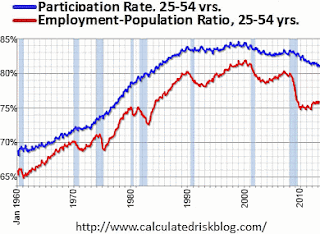
If you follow economic news, you know that the "participation rate" (the % of people who say they are actually looking for a job) has been falling in the U.S. [See the blue line in the chart.] [Source: the great Calculated Risk blog .] The overall participation rate was expected to drop as the "baby boom" generation retires. That's not the cause though. As this chart shows, the participation rate within the 25-54 year group began to fall after the dot.com bust, flattened out, and then began to fall again after the housing bust. This age group does not go back to college in huge numbers. Some of them were probably part of the huge increase in "disability" rolls . Others probably stay home with a spouse to support them, having decided to wait things out until the economy improves. Changes, by Age and Sex: How has the housing bust impacted participation rates across age and sex? For example, people around 65 years old have a lower participation r...

How're we doing on Home Prices (July 2013)?

Image
The first two measures compare prices to rents and to median income. Doing so, factors out the "nominal" aspect of price-change. Price-to-Rent ratio:   Over a year ago  this measure was almost down to the 1990 average. Since then, it has almost flattened out, falling only slightly. Source: As always the best source for such charts is the Calculated Risk blog . Price-to-Income ratio: A very similar pattern here. (Caveat: Chart only up to 2011) By both these measures, we can see that prices are slightly above their historical average, but only slightly (and way below their boom-time prices). They also seem to be flattening out. Seems a decent enough time to buy a home. Debt Obligation Ratio:  Instead of price, this measure looks at the monthly payments. Since interest rates are low (they've risen in the last month though), by this measure people are spending a historically low percentage of their incomes on mortgages. Other consumer debt is not hig...