Posts

Playboy vs. National Review

It is traditional to think of magazines like Playboy as corrupting of morals. Yet, there's no comparison to magazines like the "National Review". The wrong moral and political ideas can cause far more harm than viewing nudes. Even Venezuela's dictator Chavez realized that the "wrong ideas" about life and philosophy can be more "corrupting" than a little nudity . A while back The Simpsons were ordered off the air, to be replaced by Baywatch!

Celebrating 4th of July

Image
A couple of years ago, I was in a small mid-western resort town on July 4th and thousands of tourists (mostly from elsewhere in the state) had turned out to see the fireworks. Trucks streamed in from all the nearby little towns and farms. The atmosphere was festive. There was benevolence all around. The red-white-and blue was respected, not as a symbol of something above us on an altar, but as a symbol of who we are. Not on a pedestal to be saluted -- though that too -- but, in casual clothing, in funny head-dress, in flashing lights to be worn for the evening. All around was a feeling of family and of sharing a value. Very few cops in sight, and yet the thousands self-organizing in very orderly ways. If you asked those people, in that moment, if freedom was their top value, if the individual is important, if we should recognize the individual's right to his own life and happiness...you'd probably find lots of agreement. It's all good, but it is mostly emotional. As yo...

Novelist John Masters

John Masters's novels aren't for everyone, but I enjoy them immensely. Masters tells a good story, and tells it well. His heroes are far from perfect; they are works-in-progress, who develop through the book, occasionally tempted by Dostoyevsky-like inner dialogs. Sometimes, they weaken and succumb to temptation. The books are mostly adventures without deep themes. Indeed, the rare times that Masters tries to step back and find a broader moral theme, he is unconvincing: the narrative does not support his commentary. The books are all based in India, and the protagonists are British. Each book is set at a different time, across the few hundred of years that the British traded with and ruled India. Two of the books are set during very significant events in British-India: the 1857 mutiny (Nightrunners of Bengal) and 1947's independence (Bhowani Junction). The historical interest made me curious, but I stayed for the story, and bought the other books. Two of the boo...

Early Christianity till the 6th century

Why do some gurus endure? Jesus was not the only  Jewish preacher, and I bet Mohammad and Buddha had competition too. In modern parlance: why did they "go viral"? Christianity really took off in Rome. Buddhism declined in India, but spread in China. Clearly, early advocates -- Paul in Christianity -- were critical. I listened ( thanks to Librivox ) to about half of an old book, titled History Of The Christian Church During The First Six Centuries . The book documents Christianities leaders, branches and debates up to around 600 AD. The book documents the growth of the church. It also explains how they changed some practices -- e.g. did not insist on circumcision -- in order to make conversion more palatable to gentiles. However, the author did not explain why those gentiles (or other Jews) would switch to the Christian sect of Judaism. After Constantine moved the Roman empire to Christianity around 300AD, the rise of the religion can be explained by political spons...

Family Roots

" We come from a line of strong Norse and Celtic mix. We take what is our due ." This is a line I read from a father, to a daughter, advising her to demand something she considered her right. It is interesting how people look to their history in this way, because -- in fact -- this is myth. There's no biological transfer of philosophy across that time, and yet people invoke the myth, because it stirs emotion. It works like good heroic literature: it shows us what humans can do. We are inspired. If " these people could do so, so could I ". The emotional reality is stronger, if we add " my own ancestors could do this,… " which translates to " people just like me could do this… and, so can I ". I was always puzzled by Rand's mention of the TV series " Roots ". Though she said the author's idea of tracing his biological ancestors was tribalist, she also praised him for producing " a representative image of blac...

Metric system or Base-12 ?

The metric system (base-10) is easier to remember than older systems. Every unit is uniformly 10 times more than the next smaller one. Or 10, 100, 1000 times, if we consider only important ones. Also, by using prefixes like "kilo-" there are less words to remember. We use it in "kilogram", "kilometer". For length, we just remember "meter" and apply the prefixes. We don't have to remember: "inch", "foot", "yard", "furlong", etc. However, the older systems came about for a reason and do not pooh-pooh our ancestors for using Base-12 systems. They makes it easy to get "a quarter", "a third", or "half". If things were sold by "the tens", the green grocer could give you "a half", but couldn't give you "a third" or "a quarter" without cutting up some fruit and vegetables (or eggs). I was reminded of this recently, while watching a tu...

23andMe - The Birth of the Crony Capitalist

The FDA has now allowed 23andMe to give their customers some health-related information. This is not everything: it is only the results tat the FDA considers more reliable. On the face, this might look like a good thing, but it is probably the first step to corrupting one more little industry. Already, 23andMe is running ads saying it is the only genetic testing company offering FDA-approved health results. This is really deceptive because the FDA only approved a small slive r of their tests and because competitors can do the same even if the FDA has not approved them yet. Consider the people who run 23andMe. Until recently they were fighting against FDA control. Now, how would they view a competitor who wants to offer a non-approved test? They'll probably insist on a "level playing field". Fast forward a year or two and they'll have a relationship with the FDA and may even sue a competitor who tries to offer something new saying it does not need FDA approv...

Who needs teamsters when we have SWAT teams?

When oil was first discovered in Pennsylvania, it was transported to the nearest rail head by horse. It was poured into liquor barrels, put on a cart and pulled by a team of horses. In 1865, Samuel Van Syckel procured a right of way and built a 5 mile pipeline . He faced a lot of technical challenges. The oil had to be pumped, and the pipeline's joints would need to withstand high pressure. Van Syckel was working with 15 foot sections of 2-inch wrought pipe. After sabotage by unhappy teamsters,  he hired guards to protect the line, and it was successful enough (he charged $1 per barrel) that he built a second line soon after.  Today, pipeline builders don't just have to get a right of way from farmers. They have to petition the government. And, they do not face desperate teamsters wielding pickaxes in a futile attempt to hold back competition. Instead, the government does the job more effectively. If the people's government, duly elected, says "no", thei...

How're we doing? (A review of 2014)

Image
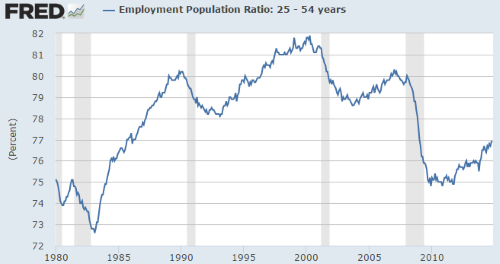
Overview:  Like last year, 2014 gave us a s lowly improving economy, and a rocketing stock market ! Since the 2007-08 downturn, most measures of the economy have stabilized and have started to improve from their bottom. Even total-employment got back, though the more important number (Employment-to-population) is still low.  The broadest GDP measure has been increasing very slowly. House-prices came well off their bottom, someway half-way to the old peak, but have recently flattened for a few months. Meanwhile, the stock market is at an all-time high. Corporate profits are high since GDP is growing slowly while firms have kept a reign on costs. Companies have kept buying back stock at above-average levels. This is different from the type of excitement that drove the dot.com boom, because it does not cascade into higher salaries and expenditures: quite the opposite. In the short/medium term, this is "blah" for employment numbers and wages. Here are some of the detail...

Personal Balance Sheet repair

Image
Private debt is often a bigger problem than government debt, in a mixed economy. Governments encourage private borrowing, and force some citizens to underwrite the losses of others. The great recession is essentially a tale of private debt gone wild. Greenspan's folly: After the dot.com bust, Americans did not tighten their belts for long. Look at the first chart. After dropping slightly for two years (2003-04), debt payments rose as a percent of disposable income. This was Alan Greenspan's "clever plan" (TM) to get out of the recession: " borrow against your house ". A  different (private) response: Then came the housing bust of the "great recession". Bernanke would have liked to repeat the Greenspan "solution", but this time, Americans were more scared. They have been repairing their balance sheets (see 2008 and beyond). Flat levels of liability:  Meanwhile, the total   level (nominal) of household liabilities has flatte...

Voters do not want to tackle entitlements

Image
In a previous post I predicted Social Security will be around for a long while. Briefly, if you are between 30 and 50 you will likely receive social security, but you will receive less than promised if you're in the upper-middle income range. (If you're 20 or so, I have no prediction to make. I wouldn't rely on it. Still, by the time you're 30, you you can re-evaluate the situation.) The math of Social Security does not add up, but each time it has faced a crisis, the tax-rate has been raised. The Wiki has a table showing how it crept up, along with a list of changes, showing how "benefits" were cut, particularly at the higher end. Even among "conservatives", only about 10% think social security should be phased out. Therefore, the program will stay. About 30% of voters, across the political spectrum, think benefits should be reduced, while the majority (60%) want the program kept as is. This means raising taxes is the most viable political s...

Corporate Tax breaks

"Tax break" is a fuzzy term, with no objective definition. Personal tax example: My taxable wages already exclude some actual wages: my deposits to a "Health care Flex account"; the amount I put into my company's 401-K savings plan; the money my company pays directly to a health-insurance company on my behalf. The government is saying that if I spend my money a certain way, they will tax me less. Already, on the top line of my tax form, I've got three "tax breaks". Continuing on, interest from municipal bonds is exempt from federal income tax. My dividends are taxed a bit lower. My investment income is broken into two parts: short-term gains and long-term gains, and I get a "tax-break" on the long-term gains. The interest I pay on my mortgage and on student loans gets  me a deduction. Supporting a child gets me another deduction. My charitable donations earn me a deduction. Once again, the government is encouraging me to spend in certai...

John Locke on innate ideas

Rand says that ideas are not innate. Even the broad axioms like "existence exists" that everyone takes for granted have to be gleaned from experience. This is contrary to epistemology that says that certain fundamental axioms are known a priori (e.g. see Ludwig von Mises). However, Rand was not unique in rejecting innate ideas. John Locke (Book 1 of " An Essay Concerning Human Understanding ") argues against the notion of innate propositions. His opponents consider notions like "What is is" (similar to "existence exists") as being innate in the human mind. Locke sets out to refute this view. Broad "speculative propositions" about existence, non-contradiction and identity are not innate, but must be discovered by man, through the use of reason. Moreover, other knowledge is not derived are a deductive conclusion from these broad propositions. Reason is the faculty to discover all knowledge: Having addressed "speculative...

Labor Participation

Image
Feb 2014 report:  "Good news" - U.S. total employment is only a few months away from reaching its peak (2007-08). The total number of people employed fell off by about 6 million people, and has now risen over 5 million from the bottom. The "bad news" is: the working-age population grew by about 12 million in the meanwhile; and employment is only just getting back to the pre-12 million level. Participation rate:  Oddly, of those 12 million, 10 million say they aren't looking for work! The "participation rate" has plunged. Today, anyone listening to business news knows that is one reason the unemployment rate has improved; i.e. fewer people have been looking for jobs. Not Early Retirement: The other day, a talking head on TV said that people are taking early retirement. Sounds plausible, but it shows ignorance. Here are two charts for U.S. men aged 55-64 The mid 1990s, saw a reversal of a long-term down-trend. Instead, more men in this age grou...

Theories of History: A survey of the "Mind drives History" theory

“... You cannot resist an idea whose time has come. ”(Victor Hugo).  Actions flow from ideas. That's why  tyrants imprison intellectuals.That's why the Stasi monitored and controlled the spread of ideas. (Movie to see: " The Lives of Others ") Religious view of History: The ancients thought God was the prime-mover of history. It was the  unfolding of His plan. For polytheists, history might be a story played out between different Gods. Man could have a role: a King or a people could make God happy or angry, driving historical reward or punishment. God might give you a promised land, or send a plague. Religious guru Pat Robertson still thinks God rewards and punishes America from time to time! Deterministic views:  Secular historians are split. Some people see little pattern and lots of accidents, while others try to integrate history more broadly, seeing either nature or man as the driver. Jared Diamond argues that geography and the availability of domesticabl...

A Debt Ceiling is a good thing

Two laws that disagree: The U.S. government budget has a deficit. This deficit adds to the debt. By approving the budget, Congress implicitly approves an increase in debt. However, the U.S. also has a debt-ceiling. Debt cannot go beyond this without Congressional approval, even if Congress has already approved a budget that pushes the debt higher. Why have two laws that can conflict? Secretary Lew says this does not make sense; but, he's wrong. The budget is only an approximate forecast, and that's all it can be. A budget might set some tax at 33% of income, but how much taxable income will people have? If it is less than forecast, the tax inflows will be less than forecast, and the deficit will be higher. Personal budget ceilings: Analogously, I might plan on buying ice-cream for the kids once a month, but the number of kids at practice varies. Across all sorts of expenditures, in some months I might blow my budget. So, I might have a second control: e.g. I will not le...

Most religious states in the U.S.

Image
Gallup just released its poll of religion across states . To be classified as "very religious" the respondent has to say that religion is important in their daily live and also that they attend religious services almost once a week. So, these are "regular church-goers" and their cohorts across other religions. The non-religious say religion is not important. The "moderately religious" say religion is important, but don;t attend regular services. The bad news is that this year's poll slightly reversed the trend, moving slightly back toward religion (this is a poll of about 175,000 people). Check out the original link, above, for a listing of all the states from high to low. I took the top ten and the bottom ten states. For these, I checked out Dave Leip's excellent " Atlas of U.S. Politics ", getting presidential results for each of these states for 1996 through 2012. I wanted to visualize red-states and blue-states, and their correla...

Personal savings flat once more

Image
A downturn in the economy or the stock-market usually causes people to pause spending to see where the chips will fall. Even people/businesses who think their jobs/revenues are relatively secure become cautious. This caution, in turn, implies less sales for some businesses, creating a downward spiral. Only to a point, though: as it spirals down, business profits start to increase and personal savings increase too. Confidence starts to come back. Savings rate: The red circles in this chart show temporary increases in the Personal Savings Rate during recessions. Unfortunately, after each recession the personal savings rate started to decline once more. We see that the savings rate has flattened once again. This is the flip-side (and downside) of confidence. [Update (2017/June: This rate still remains mostly above the 5% mark] Retirement confidence: Compared to previous years, workers who are still employed are less confident that they will have enough money to live ...

How're we doing? (A review of 2013)

Image
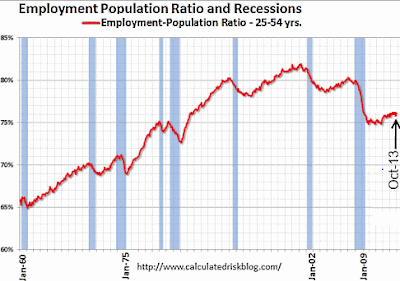
Overview:   Slow economy, rocketing stock market ! Since the 2007-08 downturn, most measures of the economy have stabilized. Despite this, total-employment is still lower. The broadest GDP measure has been increasing very slowly. Meanwhile, house-prices have turned up for the last two years, and the stock market is at an all-time high. Corporate profits are high since GDP is growing slowly while firms have kept a reign on costs. In addition, companies have been buying back stock at above-average levels . This is different from the type of excitement that drove the dot.com boom, because it does not cascade into higher salaries and expenditures: quite the opposite. In the short/medium term, this does not bode well for employment numbers and wages. Here are some of the details: Employment: Though the unemployment rate has been falling, it is mainly because so many people (particularly younger folk) have given up looking for jobs . For the core age-range 25-54 years, employ...

Twitter feed

If you use Twitter as your main article/link "feed", use the button below to get a tweet whenever a new post is added to this blog. Follow @PracGoodTheory