Posts

John Locke on innate ideas

Rand says that ideas are not innate. Even the broad axioms like "existence exists" that everyone takes for granted have to be gleaned from experience. This is contrary to epistemology that says that certain fundamental axioms are known a priori (e.g. see Ludwig von Mises). However, Rand was not unique in rejecting innate ideas. John Locke (Book 1 of " An Essay Concerning Human Understanding ") argues against the notion of innate propositions. His opponents consider notions like "What is is" (similar to "existence exists") as being innate in the human mind. Locke sets out to refute this view. Broad "speculative propositions" about existence, non-contradiction and identity are not innate, but must be discovered by man, through the use of reason. Moreover, other knowledge is not derived are a deductive conclusion from these broad propositions. Reason is the faculty to discover all knowledge: Having addressed "speculative...

Labor Participation

Image
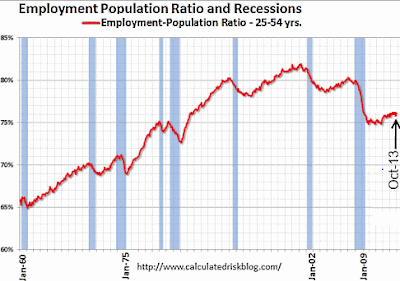
Feb 2014 report:  "Good news" - U.S. total employment is only a few months away from reaching its peak (2007-08). The total number of people employed fell off by about 6 million people, and has now risen over 5 million from the bottom. The "bad news" is: the working-age population grew by about 12 million in the meanwhile; and employment is only just getting back to the pre-12 million level. Participation rate:  Oddly, of those 12 million, 10 million say they aren't looking for work! The "participation rate" has plunged. Today, anyone listening to business news knows that is one reason the unemployment rate has improved; i.e. fewer people have been looking for jobs. Not Early Retirement: The other day, a talking head on TV said that people are taking early retirement. Sounds plausible, but it shows ignorance. Here are two charts for U.S. men aged 55-64 The mid 1990s, saw a reversal of a long-term down-trend. Instead, more men in this age grou...

Theories of History: A survey of the "Mind drives History" theory

“... You cannot resist an idea whose time has come. ”(Victor Hugo).  Actions flow from ideas. That's why  tyrants imprison intellectuals.That's why the Stasi monitored and controlled the spread of ideas. (Movie to see: " The Lives of Others ") Religious view of History: The ancients thought God was the prime-mover of history. It was the  unfolding of His plan. For polytheists, history might be a story played out between different Gods. Man could have a role: a King or a people could make God happy or angry, driving historical reward or punishment. God might give you a promised land, or send a plague. Religious guru Pat Robertson still thinks God rewards and punishes America from time to time! Deterministic views:  Secular historians are split. Some people see little pattern and lots of accidents, while others try to integrate history more broadly, seeing either nature or man as the driver. Jared Diamond argues that geography and the availability of domesticabl...

A Debt Ceiling is a good thing

Two laws that disagree: The U.S. government budget has a deficit. This deficit adds to the debt. By approving the budget, Congress implicitly approves an increase in debt. However, the U.S. also has a debt-ceiling. Debt cannot go beyond this without Congressional approval, even if Congress has already approved a budget that pushes the debt higher. Why have two laws that can conflict? Secretary Lew says this does not make sense; but, he's wrong. The budget is only an approximate forecast, and that's all it can be. A budget might set some tax at 33% of income, but how much taxable income will people have? If it is less than forecast, the tax inflows will be less than forecast, and the deficit will be higher. Personal budget ceilings: Analogously, I might plan on buying ice-cream for the kids once a month, but the number of kids at practice varies. Across all sorts of expenditures, in some months I might blow my budget. So, I might have a second control: e.g. I will not le...

Most religious states in the U.S.

Image
Gallup just released its poll of religion across states . To be classified as "very religious" the respondent has to say that religion is important in their daily live and also that they attend religious services almost once a week. So, these are "regular church-goers" and their cohorts across other religions. The non-religious say religion is not important. The "moderately religious" say religion is important, but don;t attend regular services. The bad news is that this year's poll slightly reversed the trend, moving slightly back toward religion (this is a poll of about 175,000 people). Check out the original link, above, for a listing of all the states from high to low. I took the top ten and the bottom ten states. For these, I checked out Dave Leip's excellent " Atlas of U.S. Politics ", getting presidential results for each of these states for 1996 through 2012. I wanted to visualize red-states and blue-states, and their correla...

Personal savings flat once more

Image
A downturn in the economy or the stock-market usually causes people to pause spending to see where the chips will fall. Even people/businesses who think their jobs/revenues are relatively secure become cautious. This caution, in turn, implies less sales for some businesses, creating a downward spiral. Only to a point, though: as it spirals down, business profits start to increase and personal savings increase too. Confidence starts to come back. Savings rate: The red circles in this chart show temporary increases in the Personal Savings Rate during recessions. Unfortunately, after each recession the personal savings rate started to decline once more. We see that the savings rate has flattened once again. This is the flip-side (and downside) of confidence. [Update (2017/June: This rate still remains mostly above the 5% mark] Retirement confidence: Compared to previous years, workers who are still employed are less confident that they will have enough money to live ...

How're we doing? (A review of 2013)

Image
Overview:   Slow economy, rocketing stock market ! Since the 2007-08 downturn, most measures of the economy have stabilized. Despite this, total-employment is still lower. The broadest GDP measure has been increasing very slowly. Meanwhile, house-prices have turned up for the last two years, and the stock market is at an all-time high. Corporate profits are high since GDP is growing slowly while firms have kept a reign on costs. In addition, companies have been buying back stock at above-average levels . This is different from the type of excitement that drove the dot.com boom, because it does not cascade into higher salaries and expenditures: quite the opposite. In the short/medium term, this does not bode well for employment numbers and wages. Here are some of the details: Employment: Though the unemployment rate has been falling, it is mainly because so many people (particularly younger folk) have given up looking for jobs . For the core age-range 25-54 years, employ...